What a new running community is making me think about work, belonging and flourishing in education.
How do we continue to do work that matters to us without continually depleting the resources we need to do it?
It’s a question I’ve been thinking about increasingly over the last few years. And, perhaps slightly unexpectedly, starting a running community for people who work in education has made me think about it even more.
A few weeks ago, STRIDE didn’t exist. Well, it existed in my head! But I had no idea whether anybody else would actually be interested in it.
The idea was fairly simple. I love running and I work in education. Over the years, particularly as the demands of being a headteacher have grown, running has become increasingly important to me. Not because it somehow makes the difficult parts of working in education disappear, but because it gives me something: space to think, time to reset, a challenge that is mine, sometimes connection with other people and sometimes the exact opposite — an hour completely on my own.
I wondered whether there might be something in bringing those two worlds together. So I created STRIDE: a running community for people who work in education.
A few weeks later, we’ve passed 100 members. I’m obviously delighted about that, but the number isn’t really the interesting bit.
It’s what I’m beginning to notice about the people behind it.
We all got here differently
Recently, I asked a simple question in our weekly Strides Together post: What got you into running?
The answers couldn’t have been much more varied. People talked about Couch to 5K, parkrun, friends persuading them to give it a go, family, challenges and simply wanting to get fitter.
Some had only been running for a relatively short time. Others had gone from tentative first runs to marathons, ultras and distances I’m not sure I even want to think about! Some also talked about running becoming increasingly important as their responsibilities in education grew.
There really isn’t a typical STRIDE runner.
Some people are taking their first steps into running. Others are chasing PBs. Some walk or run-walk, some love parkrun, some are training for marathons and ultras, and some simply want half an hour outside after work.
Different distances, different speeds, different motivations and different roles in education.
And yet, a community is beginning to form.
Perhaps belonging doesn’t require us to be the same
That has got me thinking about some of the research I’ve been reading while exploring the wider ideas behind STRIDE.
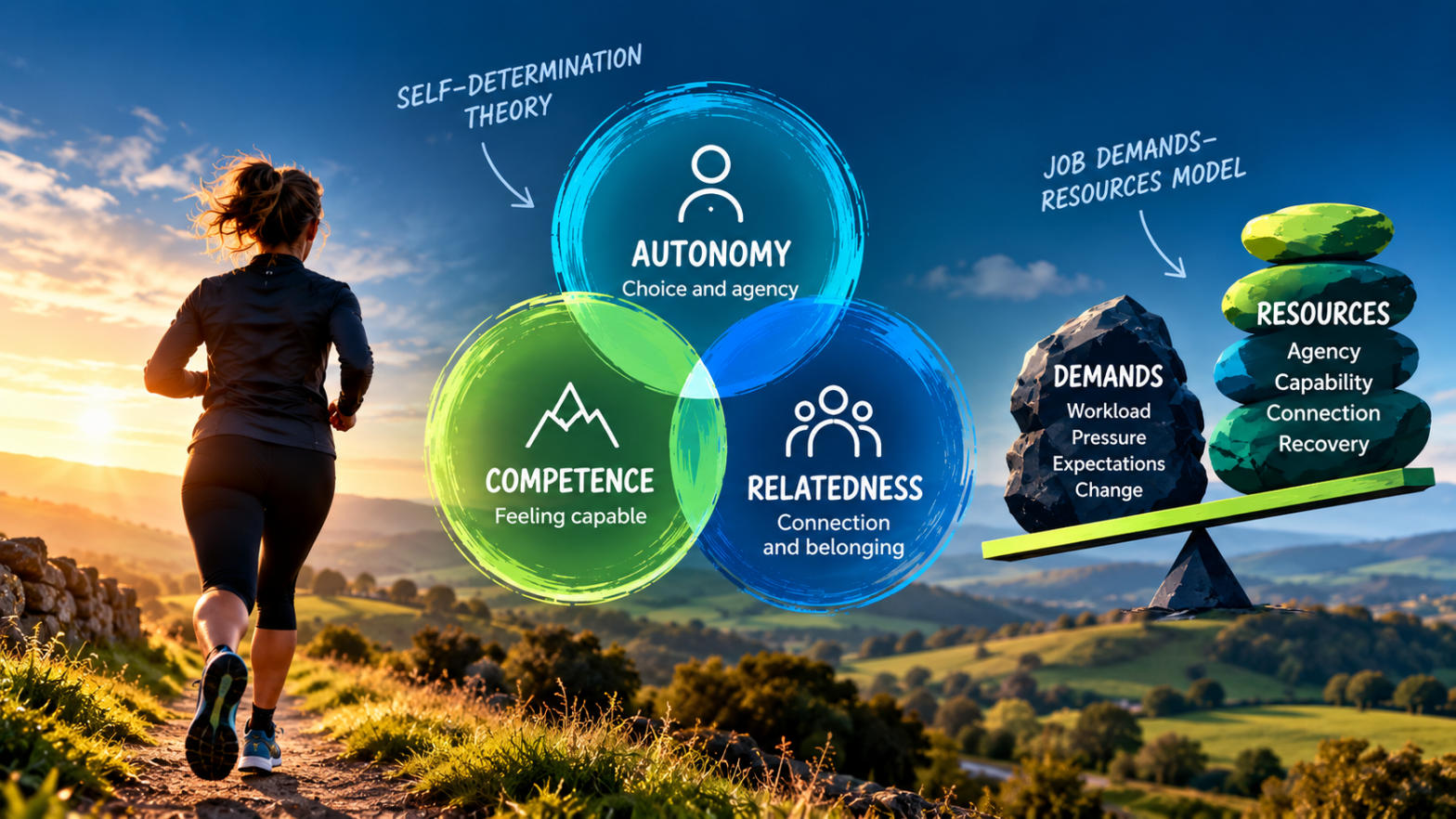
One area I’ve found particularly interesting is Self-Determination Theory, developed through the work of psychologists Edward Deci and Richard Ryan. At its heart is the idea that three basic psychological needs matter to human motivation and wellbeing: autonomy, competence and relatedness.
Put more simply, we might think about having some choice and agency, feeling capable, and experiencing meaningful connection with other people.
I’ve found myself looking at STRIDE through that lens. Nobody is being told what participation has to look like. There is no minimum pace or distance, no requirement to race and no expectation that everybody has the same goal.
We’ve said from the beginning: Participation before performance. Every stride matters.
Perhaps that matters more than I realised when I first wrote it. People can have enough in common to belong without having to become the same.
Finding your own stride
And that’s where running becomes an interesting metaphor for something much bigger.
Anyone who runs for long enough learns that there isn’t one pace that works all the time. Terrain, distance and conditions change. Sometimes you push and sometimes you recover. A stride that felt easy last week might feel difficult today.
You continually adjust.
I’ve been thinking a lot about that in relation to working in education. Education is meaningful work, but it can also be incredibly demanding work.
Perhaps sustainable working isn’t about reaching some perfect state where everything is permanently balanced and nothing feels difficult. Perhaps it is much more dynamic than that.
It’s about finding a stride you can sustain — and being able to adjust it as the demands, resources and circumstances around you change.
What helps us sustain the stride?
Another strand of research I’ve been exploring looks at the relationship between the demands people experience at work and the resources available to meet them.
The Job Demands–Resources model provides a useful way of thinking about this. Challenge itself isn’t necessarily the problem. Meaningful work can be difficult, just as training for something we care about can be difficult. There can be satisfaction in effort, challenge and achievement.
But demands become much harder to sustain when they continually consume more than we have available to meet them.
That distinction matters because the answer to unsustainable working cannot simply be telling individuals to become more resilient. And it certainly isn’t telling everybody in education to put their trainers on.
Running isn’t a cure for workload, poor organisational culture or harmful working conditions. Organisations have responsibilities too.
But movement can be one resource available to us. So can connection, developing our capability, having some influence over the things that affect us, and having opportunities to recover from periods of effort.
Those ideas — agency, capability, connection and recovery — are increasingly shaping my thinking about what it might mean to find a sustainable stride in education.
Education gives us one connection. Running gives us another.
That’s why watching the STRIDE community develop has been so interesting.
People are beginning to encourage people they’ve never met, share stories and discover common ground. Completely different distances are contributing towards the same community challenge. Someone’s short walk can sit alongside somebody else’s Sunday long run; someone completing their first 5K can belong alongside somebody training for an ultra.
Nobody has to earn their place.
Perhaps the thing we share isn’t how we run. It’s that we run.
Alongside that is another shared experience: we work in education.
Teachers, teaching assistants, headteachers, support staff and people working across the wider education system might have very different roles, but there are parts of working in education that we understand about one another without much explanation.
Education gives us one connection. Running gives us another.
Somewhere between the two, STRIDE is beginning to find its identity.
So what does it mean to find your stride?
I’m very conscious that a running community only a few weeks old isn’t a research study. The conversations taking place within STRIDE don’t prove anything.
But they are making me curious.
They’re making me think more deeply about agency, capability, connection, recovery, demand and the conditions that enable people to sustain meaningful work over time. And they’re making the phrase find your stride mean something slightly different to me.
It isn’t about finding the right way, and it certainly isn’t about finding somebody else’s way.
It’s about understanding the demands you’re facing, the resources available to you and the things you can influence — and then being able to adjust as circumstances change.
Just like running, sometimes that might mean pushing. Sometimes it might mean slowing down or recovering. Sometimes it might mean asking for support or changing direction.
And sometimes the problem isn’t your stride at all.
It’s the conditions you’re being asked to run in.
That matters, because sustainable flourishing in education cannot only be the responsibility of the individual. If the conditions themselves are creating persistent and avoidable depletion, asking somebody to become better at coping with them isn’t enough.
STRIDE is still very new and I’m still learning. But perhaps that’s what we’re beginning to explore: how we find our own stride, how we help others find theirs, and how we create conditions across education in which more of us can sustain it.
We Run. We Belong. We Flourish.
Helping education move.
What does running give you?
STRIDE Stories are real experiences from people working across education — sharing what running, movement and community mean to them.
Share your story → hello@stride-education.org
Stay part of the STRIDE journey.
STRIDE is growing — and there’s more to come.
Subscribe for member stories, community challenges, practical ideas for finding your stride, and new thinking about sustainable working and flourishing in education.
No clutter. Just occasional emails worth opening.
By subscribing, you agree to receive occasional emails from STRIDE. You can unsubscribe at any time. See our Privacy Policy.

